Digital Onboarding
Digital onboarding has become one of the most essential pillars of modern business transformation. As companies move away from traditional paperwork and manual verification, they increasingly rely on digital tools to authenticate users, streamline registration, meet compliance standards, and create frictionless experiences.
From banks and fintechs to e-commerce and telecom companies, digital onboarding is redefining how organizations welcome new customers.
This comprehensive guide explores the core components of digital onboarding, covering customer verification, automation, compliance, and user experience optimization to help businesses implement smarter, faster, and safer onboarding processes.
| Category | Key Insight |
| Customer Verification | Confirms identity using documents, biometrics, liveness checks, and database validation. |
| Automation | Speeds up onboarding by automating data capture, fraud checks, and approval decisions. |
| Compliance | Ensures adherence to KYC, AML, GDPR, and regional regulations through automated checks. |
| User Experience | Uses mobile-first design, minimal steps, and real-time feedback to reduce drop-offs. |
| Security | Protects data with encryption, biometric authentication, and AI-driven risk scoring. |
| Scalability | Enables global onboarding with standardized digital KYC processes. |
| Operational Efficiency | Lowers costs by reducing manual reviews and paperwork. |
| Conversion Rates | Frictionless onboarding increases registration completion and user satisfaction. |
What Is Digital Onboarding?
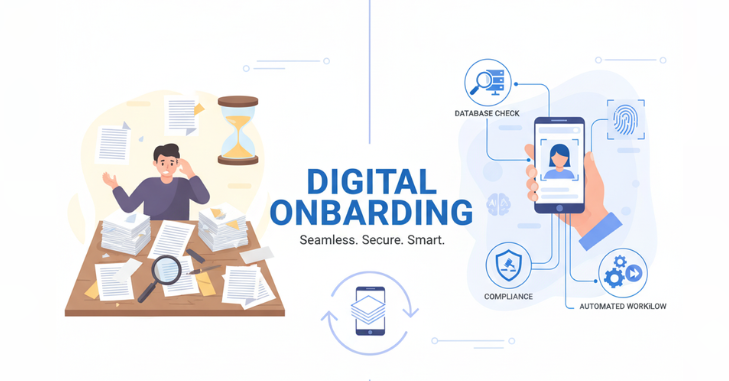
Digital onboarding is the end-to-end process by which customers register, verify their identity, and gain access to a company’s services entirely online.
Unlike traditional onboarding, which relies on physical documentation, face-to-face verification, or manual data entry, digital onboarding uses automated workflows, artificial intelligence (AI), biometrics, and secure data capture.
Why Digital Onboarding Matters Today?
- Customers expect seamless, mobile-first experiences
- Businesses need faster ways to verify identities
- Regulatory requirements demand strong KYC/AML processes
- Competitive markets require superior user experiences
- Automation reduces operational costs and human error
As industries rapidly adopt remote-first strategies, digital onboarding has become a necessity rather than a luxury.
The Evolution of Onboarding

Traditional Onboarding
Traditionally, onboarding involved:
- In-person verification
- Physical forms
- Manual document review
- Long processing times
This method was slow, costly, and frustrating for customers.
Rise of Digital Solutions
The shift occurred due to:
- Smartphones becoming universal
- Increased trust in online services
- Regulatory bodies accepting digital KYC
- Availability of AI-based verification tools
Modern Digital Onboarding
Today’s systems focus on:
- Instant verification
- Paperless workflows
- Real-time compliance
- Automated decision-making
The goal is to reduce friction, speed up approval, and enhance security simultaneously.
Key Components of Digital Onboarding

Customer verification is the heart of digital onboarding because it confirms that the account creator is genuine. This process protects businesses from fraud, identity theft, and unauthorized access, ensuring a secure start to the customer relationship.
Verification usually begins with document verification, where users submit government-issued IDs such as ID cards, passports, or driver’s licenses. Another essential step is liveness detection, which ensures that the user is physically present during verification rather than using a static image or pre-recorded video.
This prevents impersonation and spoofing attempts. Biometric authentication further strengthens security by leveraging technologies such as facial recognition, fingerprint matching, and voice authentication to verify identity with high accuracy. To complete the process, database checks compare the customer’s information with official government databases or trusted third-party sources.
Automation
- Auto-reading IDs
- Autofilling customer data
- Automated fraud detection
- Instant approval or rejection
- Workflow triggers for next steps
- Reduces onboarding time
- Cuts operational costs
- Improves accuracy
- Enhances customer experience
Compliance Management
- KYC
- AML
- GDPR
- CCPA
- FATF guidelines
- Securely storing customer data
- Maintaining audit trails
- Applying risk scoring
- Automatically checking watchlists (e.g., sanctions, PEP lists)
User Experience Optimization
A seamless onboarding experience increases conversion rates and reduces user dropout.
1. Mobile-First Design
The majority of users complete onboarding through their smartphones, so the process must be fully optimized for smaller screens. A mobile-first design ensures that forms, buttons, and verification steps load quickly and function smoothly. This leads to fewer drop-offs and a much more user-friendly onboarding flow.
2. Minimal Steps
Reducing the number of screens and actions required during onboarding significantly boosts completion rates. Customers prefer fast, simple journeys that eliminate unnecessary fields or repetitive information requests. A streamlined process increases satisfaction and reduces the chance of users abandoning registration.
3. Simple Language & Clear Instructions
Clear, easy-to-understand instructions help guide customers through each step without confusion. Simplified language reduces errors and prevents delays in document submission or data entry. A well-explained process encourages trust and leads to smoother overall onboarding.
4. Real-Time Feedback
Providing instant feedback lets users know immediately when an image is blurry, a document is unreadable, or information is missing. This prevents frustration caused by repeated attempts or rejected submissions. Real-time guidance ensures accuracy and speeds up the verification process.
5. Secure but Fast
Customers expect strong security, but they don’t want it to slow them down. Balancing advanced verification tools with fast processing times ensures a smooth yet protected onboarding experience. The goal is to provide maximum safety without adding unnecessary friction to the user journey.
Benefits of Digital Onboarding

Digital onboarding offers numerous benefits by transforming the customer registration process into a fast, secure, and user-friendly experience. What once required days for approval can now be completed in minutes, dramatically speeding up customer activation.
Advanced technologies such as AI, biometrics, and encryption enhance security and reduce the risk of fraud, ensuring that only legitimate users gain access. Automation also lowers operational costs by reducing the need for large manual review teams.
At the same time, customers enjoy a smoother, more convenient onboarding process, leading to higher satisfaction, stronger retention, and increased loyalty. Digital solutions are easily scalable across different regions, enabling businesses to onboard customers from anywhere in the world without physical limitations.
Common Industries Using Digital Onboarding
Digital onboarding is widely used across sectors:
- Banking & Fintech (account opening, loans)
- Telecommunications (SIM registration, service activation)
- Healthcare (patient verification)
- E-commerce (seller and customer onboarding)
- Insurance (policy applications)
- Real Estate (tenant verification)
- Travel & Hospitality (digital check-ins)
Each industry tailors onboarding based on compliance and user needs.
Digital Onboarding Workflow: How It Works?
A typical digital onboarding flow includes:
- Customer signs up
- Uploads ID or scans a document
- Completes liveness test
- System verifies document authenticity
- Data is checked against databases
- An automated decision is made
- Account is activated
- Customer receives confirmation
This process usually takes 3–5 minutes or less with modern technology.
Traditional vs. Digital Onboarding
| Criteria | Traditional Onboarding | Digital Onboarding |
| Speed | Slow (days/weeks) | Instant or minutes |
| Process Type | Manual paperwork | Automated, paperless |
| Identity Verification | In-person | AI, biometrics, online checks |
| Accuracy | Human errors | High accuracy with AI |
| User Experience | Time-consuming | Fast, mobile-friendly |
| Compliance | Manual audits | Automated KYC/AML checks |
| Cost | High operational cost | Lower cost due to automation |
| Accessibility | Location-based | Global, remote onboarding |
| Fraud Risk | Higher | Strong biometric + AI protection |
| Scalability | Limited | Easily scalable |
Challenges in Digital Onboarding
Fraud Attempts
Scammers use deepfakes, forged IDs, or stolen data.
Device Compatibility Issues
Low-quality cameras or old devices can cause verification errors.
Complex Regulations
Businesses must keep up with changing compliance laws.
Balancing Security vs Convenience
Too many steps frustrate users; too few increase risk.
Data Privacy Concerns
Sensitive user information must be handled with extreme care.
Future of Digital Onboarding
Digital onboarding is evolving rapidly as advanced technologies continue to shape the future of identity verification and customer authentication. Artificial intelligence and machine learning are becoming essential, enabling more accurate document analysis, stronger fraud detection, and predictive risk scoring that helps organizations identify threats before they occur.
Blockchain-based identity management is also emerging as a powerful tool, offering decentralized digital identities that significantly reduce the risk of identity theft. At the same time, advances in biometrics, such as improved face recognition, iris scanning, and voice biometrics, are making verification faster and more reliable.
Conclusion
Digital onboarding has become a critical part of the customer journey. It empowers businesses to securely verify identities, automate manual tasks, meet compliance standards, and deliver exceptional user experiences. As customers demand faster and more convenient onboarding, companies must invest in advanced digital solutions.
With the right tools, AI, biometrics, automation, and compliance frameworks, organizations can transform onboarding from a frustrating barrier into a seamless first impression that builds trust, boosts conversions, and enhances customer satisfaction.
Want to know about Guide to the Best Bone Conduction Headphones, Earbuds, and Speaker Headphones in the UK – Comfort, Sound Quality & Battery Life Compared Check out our Technology category.
FAQs
It’s faster, more secure, more convenient for users, and highly scalable across large customer bases.
AI instantly detects fake IDs, mismatched biometrics, deepfakes, and suspicious patterns.
It reduces costs, speeds up customer approval, improves compliance, and increases conversions.
The process of integrating new workers or clients into a company using digital tools and platforms is known as “digital onboarding.” This effectively simplifies what was previously a laborious and painstaking process.