Short answer: A domestic partner is a person in a committed relationship with another adult, usually sharing a home and personal or financial responsibilities without being married. Some states, cities, employers, and benefit plans formally recognize these relationships. The rights available depend on the laws and policies that apply where you live or work. More from us: Misfeasance.
That last point matters. Being an unmarried couple is not always the same as having a legally registered domestic partnership. There is no single set of rules that applies to every couple across the United States. State laws, local regulations, employer policies, and federal programs may treat these relationships differently.
| Key question | What to know |
| Basic meaning | A committed relationship between two adults who are not married to each other |
| Registration | Some jurisdictions provide a formal registry, while others do not. |
| Eligibility | Requirements vary by jurisdiction or benefit plan. |
| Possible benefits | Health coverage, leave, property, inheritance, or other protections may apply. |
| Federal taxes | Registered partners generally are not treated as married for federal income tax purposes. |
| State rights | Protections can range from limited benefits to rights similar to those of married couples. |
| Best first step | Check your state, city, employer, and benefit plan rules. |
The key distinction is recognition. A couple can share a home, finances, children, and a long-term commitment without automatically receiving all the legal protections associated with marriage.
What Qualifies Someone as a Domestic Partner?

There is no single nationwide eligibility test. Requirements depend on the government agency, employer, insurer, or other organization defining the relationship. For example, some government agencies define a domestic partnership as a committed relationship between two adults who are each other’s sole partner and intend for the relationship to continue. Such definitions apply within specific legal or administrative contexts and do not create a universal rule across the United States.
Depending on the applicable rules, common requirements may include:
- Both people are adults and capable of consenting to the relationship.
- Neither person is married to or partnered with someone else.
- The couple shares a committed personal relationship.
- The partners may need to share a primary residence.
- A registry or employer may request evidence of financial interdependence.
- The couple may need to file a declaration or affidavit.
- Some programs may impose additional eligibility or waiting-period requirements.
Living together for a specific number of years does not automatically create this status everywhere. Registration may be required in places where a formal legal relationship is available.
How Does a Domestic Partnership Differ From Marriage?
Marriage receives broad recognition under state and federal law. Domestic partnerships depend much more heavily on the jurisdiction that creates or recognizes them.
Some states grant registered partners extensive rights under state law, while others offer fewer protections or lack a statewide domestic partnership system. Federal treatment may also differ from state treatment.
| Issue | Domestic partnership | Marriage |
| Availability | Depends on state or local law | Available nationwide |
| Federal tax status | Generally not treated the same as marriage | Recognized as marriage |
| State protections | Vary widely | Broad spousal protections |
| Registration | May require a special declaration | Usually requires a marriage license and compliance with legal requirements. |
| Employer benefits | Depend partly on the employer or plan | Spouses are commonly recognized. |
| Ending the relationship | The procedure depends on the jurisdiction. | Usually requires a formal divorce or annulment process |
One major difference appears in federal income tax treatment. Registered partners generally cannot choose married filing jointly or married filing separately solely because a state or local government recognizes their domestic partnership.
Which Rights and Benefits May Apply?

A domestic partner may receive certain protections if the applicable state, city, employer, or benefit plan recognizes the relationship. Possible benefits may include health plan eligibility, family or bereavement leave, hospital visitation rights, and certain inheritance or property protections.
However, these benefits should not be assumed without checking the specific rules that apply.
State differences can be substantial. Some jurisdictions provide registered partners with extensive state-law protections, while others provide limited rights or no comparable statewide registration system.
Federal programs can add another layer of complexity. Certain non-marital legal relationships may qualify for specific benefits when all applicable requirements are met. For this reason, it is safer to verify eligibility directly rather than assume automatic coverage or automatic exclusion.
Health Insurance Can Have Its Own Rules
Employer-sponsored health coverage is one reason couples often investigate formal partnership status. An employer or insurance plan may recognize an unmarried partner, but eligibility requirements vary.
Some plans may require a registration certificate, an affidavit, proof of shared residence, or evidence of financial responsibility. Others may use their own definition of an eligible partner.
This means that government registration does not necessarily answer every workplace benefits question.
Tax treatment also deserves attention. Federal tax rules do not always treat benefits provided to an unmarried partner in the same way as benefits provided to a qualifying spouse or dependent. Couples should review current plan documents and applicable tax rules before estimating the actual cost of coverage.
How Registration Usually Works
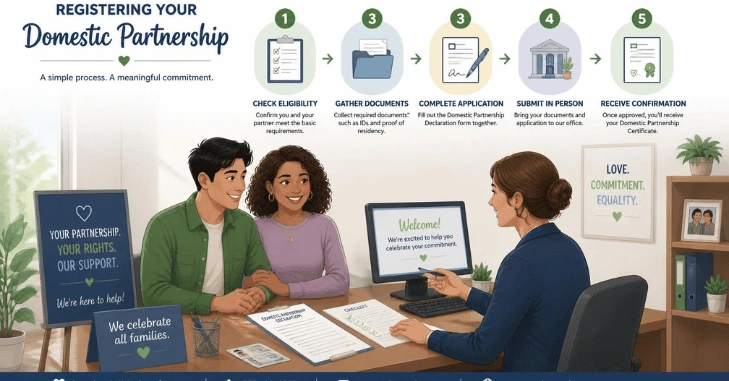
Where registration is available, couples normally file paperwork with the designated state or local government office. The application may require both people to confirm that they meet the jurisdiction’s eligibility requirements.
Depending on the location, couples may need to complete a declaration of domestic partnership, provide identification, pay a filing fee, or submit supporting documents.
Do not assume that registration in one jurisdiction guarantees identical treatment elsewhere. Before relying on the status for insurance, inheritance, taxes, or another major decision, verify how the relevant organization recognizes it.
Legal Documents May Still Matter
Formal relationship status does not eliminate the need for basic legal and financial planning.
Depending on local law and your circumstances, couples may want to review:
- Beneficiary designations
- Wills
- Powers of attorney
- Property ownership
- Healthcare authorization documents
- Agreements covering shared finances
These documents can become especially important when a jurisdiction provides fewer automatic protections than marriage.
A qualified local attorney can explain which rights arise automatically and which protections require separate legal documents.
Magazine readers researching related topics can also browse the Law section for additional legal explainers.
If a married couple is dealing with an agreed separation instead, Magazinezine’s guide to uncontested divorce and asset division covers a different legal process involving spouses.
Readers interested in broader personal and relationship topics can also explore the Lifestyle section.
Know Which Rules Apply Before Relying on the Label
The term can describe a committed unmarried relationship, but its legal effect depends on the context. State law may provide substantial protections, while an employer, insurer, or federal program may apply different standards.
Before making decisions about health coverage, taxes, property, inheritance, or benefits, check the current rules for your jurisdiction and the specific program involved.
For individual legal or tax questions, seek advice from a qualified professional who can review your circumstances and explain the rules that apply to you.
What Happens When the Relationship Ends?

Ending a registered partnership is not always as simple as moving apart. A jurisdiction may require a termination filing or another formal legal process.
Property, debt, support obligations, parenting issues, and jointly owned assets can complicate separation. The applicable rules may also depend on where the partnership was registered and where the couple lives when the relationship ends.
If significant property, children, retirement assets, or disputed finances are involved, local legal advice can help clarify the consequences before either person signs documents or transfers property.
Conclusion
A domestic partner is generally an unmarried person in a committed relationship, but the legal rights attached to that relationship can vary significantly depending on the state, local jurisdiction, employer, insurance plan, and government program involved. Simply living together or sharing finances does not automatically guarantee the same protections available to married couples.
Before relying on domestic partner status, couples should confirm whether registration is required and carefully review the rules governing health insurance, taxes, inheritance, property, workplace benefits, and other legal matters. Important protections may also require separate documents such as wills, powers of attorney, healthcare directives, and beneficiary designations.
Frequently Asked Questions
Possibly. Some employers and insurance plans provide coverage for qualifying unmarried partners, while others use different eligibility rules. Check your plan documents and ask the benefits administrator what evidence or documentation is required.
In many cases, a shared household is part of the eligibility criteria, but the requirement is not universal. The exact rule depends on the jurisdiction, employer, insurer, or benefit program whose recognition you are seeking.
Generally, registration as domestic partners does not allow a couple to file a federal income tax return as married solely because of that registration. Federal tax treatment can differ from state recognition, so couples should check the rules that apply to their specific circumstances.
Is Domestic Partnership Status the Same in Every State?
No. Recognition, registration requirements, legal rights, and termination procedures vary among states and local governments. Some jurisdictions provide extensive protections, while others provide limited recognition or no formal registration system
Not necessarily. Cohabitation alone should not be assumed to establish a formally registered relationship. Check the laws where you live and the rules of the organization from which you are seeking benefits.
There is no single answer that applies to every couple. Marriage and domestic partnership status can affect taxes, benefits, inheritance, property rights, retirement planning, and separation in different ways. Compare the rules that apply to your location, finances, and personal circumstances before making a decision